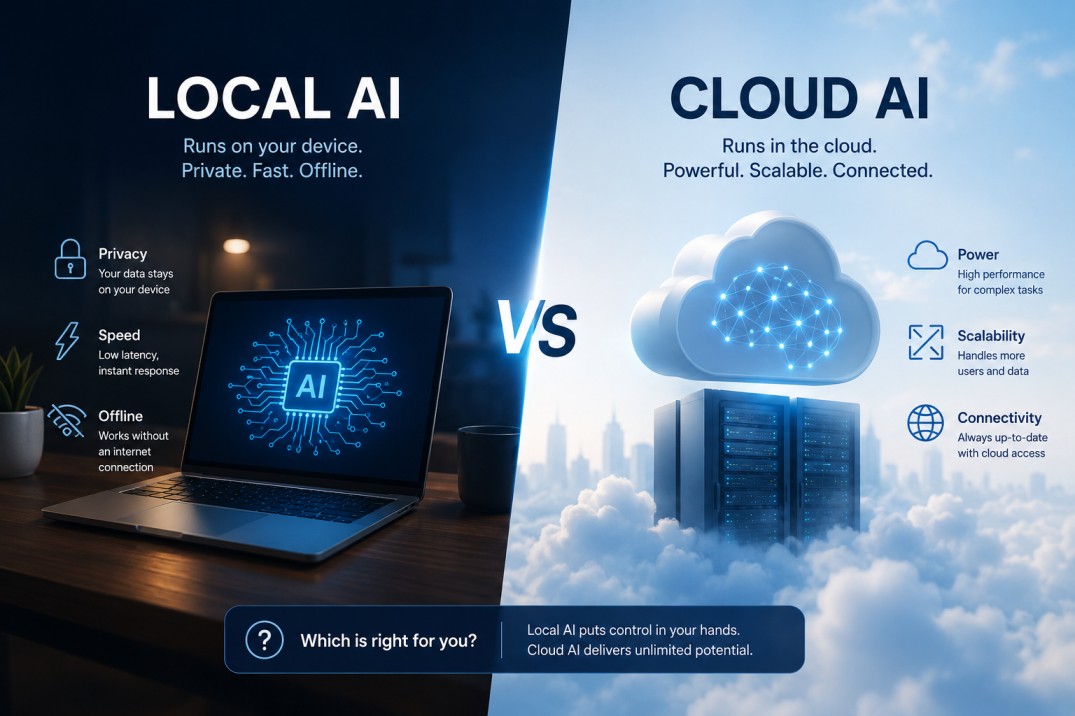
Local AI and cloud AI are often seen as competing technologies. Most people are busy debating which one is better.
But that’s the wrong question.
What’s actually happening is that a quiet skill gap is opening up, and almost nobody is paying attention to it.
The Reality: Local AI Is Still Behind
As of 2026, local AI is not competing with top cloud models.
Agentic workflows, coding assistants, and complex reasoning are still dominated by cloud systems. Tools like Claude (especially in coding scenarios) are significantly ahead.
From practical experience:
- Local models struggle with multi-tool workflows
- They break under larger context windows
- They become inconsistent in long tasks
“Vibe coding” with local models sounds good in theory, but in reality, it falls apart quickly once the project grows.
So the obvious question is:
If local AI is worse, why should you care?
Because the Market Doesn’t Care About “Better”
The job market doesn’t need local AI to outperform cloud AI.
It needs people who can run AI locally when cloud is not an option.
There are real environments where data cannot leave the system:
- Hospitals (patient data)
- Banks (financial records)
- Defense systems (air-gapped infrastructure)
- Enterprises with strict compliance
And in these cases, cloud AI is simply not usable.
The Market Is Already Moving
The numbers support this shift.
Edge AI is already a ~$25B market (2025) and projected to grow to over $140B by 2034, with ~21% CAGR. That’s not hype—that’s sustained industry direction.
Real-world deployments already exist:
- General Dynamics Information Technology demonstrated an air-gapped AI appliance with Google Cloud in a military exercise (Mobility Guardian 2025)
- Siemens Healthineers is running AI for radiation treatment planning fully at the edge
These are production systems—not experiments.
And all of them require engineers who understand local AI inference and deployment.
The Skill Gap (Backed by Data)
According to the Stack Overflow Developer Survey 2025:
- 84% of developers use AI tools
- But only ~18% are building AI integrations
- A large portion plan to use AI for deployment and monitoring—but haven’t yet
That means most developers are:
- Using APIs
- Writing prompts
- Relying on cloud tools
But very few know how to:
- Deploy a model
- Optimize it for hardware
- Run inference locally
That gap is real—and growing.
My Experience: Where Local AI Breaks
About a year ago, I had no understanding of how any of this worked internally.
Since then, I’ve spent hundreds of hours testing local models on my RTX 5060.
I’ve built full-stack apps using cloud tools like ChatGPT and DeepSeek, and then tried doing the same locally.
The difference is obvious:
- Local models struggle with scale
- Context windows fill up fast
- Inference becomes slow
- Errors increase significantly
In many cases, I ended up spending more time debugging than actually building.
Where Local AI Actually Works
After all that experimentation, one thing became very clear:
Local AI works best for boring, well-defined problems.
For example, speech-to-text is basically solved.
Using Faster Whisper (Large V3 Turbo), I built a pipeline:
- Raw video → speech-to-text → raw transcript
- Raw transcript → local LLM → cleaned transcript + insights
This setup:
- Runs 100% locally
- Produces reliable results
- Keeps full data ownership
And performance is comparable to many cloud solutions.
Other strong use cases:
- Document processing
- Image recognition
- Image generation
- Internal code assistants (private repositories)
These are not flashy demos—but they are exactly what enterprises need.
The Pattern Most People Miss
Across all working use cases, a clear pattern appears:
- They are structured
- They are repetitive
- They are privacy-sensitive
And most importantly:
They are boring.
But those “boring” problems are where real money is.
The Shift to Hybrid AI
According to data referenced by Yahoo Finance and edge platforms like ZEDEDA:
- ~47% of enterprises are already using hybrid cloud-edge architectures
- Compared to ~24% relying purely on centralized cloud
This is where things are going.
The future is:
- Cloud AI → complex reasoning, agentic workflows
- Local AI → high-volume, private, controlled tasks
How to Get Started
If you’re a backend engineer and understand Docker, you’re already close.
Start with:
- Running local models using tools like LM Studio
- Connecting them to editors like Continue
- Testing models like Qwen locally
You won’t match cloud performance—but that’s not the goal.
The goal is to understand:
- Behavior
- Limitations
- Deployment
If you’re in DevOps, MLOps, or infrastructure, this is even more relevant—you already have 70% of the required skillset.
The Opportunity
Universities haven’t caught up yet.
Most courses still focus on:
- Theory
- Model training
- Basic AI usage
Very few teach:
- Local deployment
- Edge inference
- Hardware optimization
Which means:
The barrier to entry is low—but only for now.
Final Thoughts
Local AI is not here to replace cloud AI.
It doesn’t need to.
What matters is this:
There is a growing demand for engineers who can run AI where others cannot.
Right now, most developers are focused on prompts, APIs, and cloud tools.
But a much smaller group is quietly learning how to:
- Deploy models
- Optimize them
- Run them in private environments
That’s where the real gap is.
And opportunities like this don’t stay hidden forever—once the market catches on, the advantage disappears.
The question is simple:
Do you want to follow the trend… or get ahead of it?